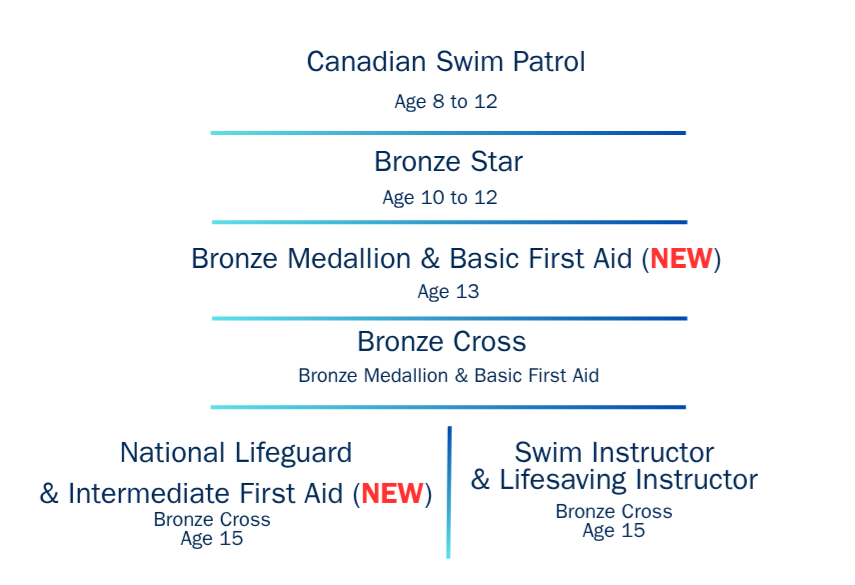
We offer lifeguard certification courses for all ages through and the Lifesaving Society. If you are interested in teaching swimming, becoming a lifeguard or improving your safety skills, you'll need to take these programs.
Canadian Swim Patrol - Rookie Patrol
Recommended pre-requisites: Swimmer 6, 8yrs of age
In Rookie, the first level in the Canadian Swim Patrol Program, swimmer continue stroke development with 50 metre swims of front crawl, back crawl and breaststroke. Lifesaving Sport skills include a 25 metre obstacle swim and 15 metre object carry. First aid focuses on assessment of conscious victims, contacting EMS and treatment for bleeding. Fitness improves in 350 metre workouts and 100 metre timed swims.
Canadian Swim Patrol - Ranger Patrol
Recommended pre-requisites: Swimmer 6, 8yrs of age, and completion of Rookie
In Ranger, the second level in the Canadian Swim Patrol Program, swimmers develop better strokes over 75 metre swims of each stroke. They tackle Lifesaving Sport skills in a lifesaving medley, timed object support and rescue with a buoyant aid. First aid focuses on assessment of unconscious victims, treatment of victims in shock and obstructed airway procedures. Skill drills develop a strong lifesaving foundation.
Canadian Swim Patrol - Star Patrol
Recommended pre-requisites: Swimmer 6, 8yrs of age, and completion of Ranger
In Star, the third and final level of the Canadian Swim Patrol Program, swimmers are challenged with 600-metre workouts, 300-metre timed swims and a 25-metre object carry. Strokes are refined over 100-metre swims. First aid focuses on treatment of bone or joint injuries and respiratory emergencies including asthma and allergic reactions. Lifesaving skills include defense methods, victim removals and rolling over and supporting a victim face up in shallow water.
Bronze Star
Recommended pre-requisites: Swimmer 6 and 10yrs of age (Canadian Swim Patrol recommended)
Bronze Star is an excellent preparation for success in Bronze Medallion. Participants develop problem solving and decision making skills as individuals and partners. They learn CPR and develop water smart confidence and the lifesaving skills needed to be their own personal lifeguard. The minimum prerequisite for this program is Swimmer 6 and 10 years of age. Canadian Swim Patrol is recommended.
Basic First Aid
Learn essential first aid skills to confidently respond to common injuries and emergencies. This course covers topics such as wound care, CPR basics, choking response, and injury prevention, equipping participants with practical, hands-on skills for everyday situations.
This course will be offered with the Bronze Medallion program.
Bronze Medallion
Pre-requisites: 13yrs of age or Bronze Star
The Bronze Medallion course challenges participants to develop the essential skills and knowledge required for lifeguarding and aquatic safety. Candidates will build endurance through a timed swim, rescue skills, and decision-making skills through hands-on practice in water rescue techniques, first aid scenarios, and teamwork exercises. An examiner will evaluate your skills at the end of the course. 100% attendance is mandatory.
Bronze Cross
Pre-requisites: 14yrs of age, Bronze Medallion and Basic First Aid
The Bronze Cross Program builds on the Bronze Medallion skills with a focus on advanced water rescues, spinal injury management, teamwork, and supervision in aquatic settings. This course prepares candidates for lifeguarding duties and is a key step toward National Lifeguard certification. An examiner will evaluate your skills at the end of the course. 100% attendance is mandatory.
Swim and Lifesaving Instructors
Pre-requisites: 15yrs of age, Bronze Cross
This is a two certification course. The Lifesaving Society Swim Instructor Course prepares the candidate to teach and evaluate the swimming strokes and related skills found in the Lifesaving Society's Swim for Life Program.
The Lifesaving Instructor course prepared the candidate to organize, plan, teach and evaluate lifesaving and first aid skills as well as resuscitation techniques to instruct Lifesaving Society's Canadian Swim Patrol, Bronze Medallion, and Bronze Cross. 100% attendance is mandatory.
Intermediate First Aid
The intermediate first aid program builds on basic first aid skills with a deeper focus on assessing and responding to more complex injuries and emergency situations. This course includes hands-on training in patient assessment, CPR, and managing a variety of medical emergencies.
This course will be offered with National Lifeguard Service.
National Lifeguard Service
Pre-requisites: 15yrs of age, Bronze Cross
The National Lifeguard (NL) certification is Canada’s professional standard for lifeguarding. This comprehensive course builds on foundational lifesaving skills and prepares candidates to effectively prevent, recognize, and respond to aquatic emergencies in pool environments. Participants will develop advanced rescue techniques, accident prevention strategies, teamwork skills, and strong judgement and decision-making skills. The program includes fitness standards, surveillance techniques, emergency response protocols, and hands-on practice.
Successful completion of the National Lifeguard certification is required for employment as a lifeguard. An examiner will evaluate your skills at the end of the course. 100% attendance is mandatory.
Leadership program benefits
These programs help teach teamwork, problem solving, time management, physical fitness and communication skills. You will also gain job skills that help develop self-confidence. Instructor and lifeguard positions are paying part-time jobs and provide great experience for résumés.